

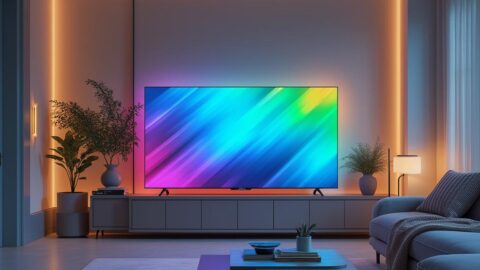
In the ever-evolving home entertainment landscape, 2025 marks a pivotal year for OLED (organic light-emitting diode) smart TVs. Offering unparalleled picture quality and a wealth of intelligent features, these televisions have become the cornerstone of home theaters worldwide. This article explores the maze of options available this year, highlighting the best models, their strengths, weaknesses, and added value for modern viewers.
Initially, OLED technology gained prominence in the consumer electronics market thanks to its exceptional color accuracy and contrast. Unlike traditional LED screens, OLED panels diffuse their light, eliminating the need for backlighting. This results in deeper blacks and more vibrant colors, setting a new standard for image quality.
By 2025, brands like LG, Sony, and Samsung stand out, each offering distinct advantages. LG, unparalleled in its commitment to OLED innovation, surprises its audience with the G3 series, featuring an even thinner design and enhanced brightness. The starting price is around $2,500 for a 55-inch model. Backed by LG's strong reputation for quality, the G3 comes with a comprehensive 5-year parts and labor warranty.
Sony's A95K series has become synonymous with cinematic experiences. Thanks to the XR Cognitive Processor, it analyzes content in the same way humans perceive the world, enhancing every element of the viewing experience. Priced at approximately $3,200, it emphasizes audio quality with Acoustic Surface Audio technology, transforming the screen into a speaker for an immersive listening experience. Sony backs this innovation with a 4-year warranty, including a free annual check-up.
Samsung's QD-OLED, featuring a quantum dot layer, offers increased color depth and longevity, addressing the common OLED ghosting issue. Starting at $2,800, this model boasts smart features and seamlessly integrates with Samsung's connected devices. It comes with a 3-year warranty, extendable to 5 years for an additional fee.
TCL is entering the OLED 2025 race with its X10 series, a competitive offering. Aimed at budget-conscious consumers, TCL manages to maintain a delicate balance between affordability and high performance. Starting at $1,800, the X10 series uses cutting-edge technology to deliver Dolby Vision IQ, which automatically adjusts settings based on ambient conditions. This affordable option includes a 3-year warranty with an optional extended warranty.
Regarding potential drawbacks, OLED TVs, despite their excellence, still present some challenges. The risk of image retention, or "burn-in," remains a subject of debate. However, manufacturers are increasingly implementing features to mitigate this risk. For example, pixel-shifting technologies and panel optimization routines are now standard on many models.
Furthermore, while the price may seem high, experts say it's the result of years of research and development dedicated to picture quality and improved features. Bob Smith, a renowned industry analyst, believes that investing in an OLED TV represents a long-term commitment to superior home entertainment.
Another point to consider is energy consumption. OLEDs, generally more efficient than their LED counterparts at displaying dark scenes, can consume more energy for brighter images. This is a crucial aspect for environmentally conscious buyers. However, most high-end models offer energy-saving modes to mitigate this issue, even if it slightly reduces image quality.
In retrospect, the evolution of OLED technology is closely linked to consumer expectations. The first OLED screens, launched at the beginning of the 21st century, were compact and designed for mobile devices. By 2025, the transformation is evident in the large and visually striking panels of today's OLED televisions.
In conclusion, choosing an OLED smart TV in 2025 isn't just about choosing a screen; it's about choosing a gateway to a world of immersive entertainment. Whether it's the sleek design of LG, the cinematic sound of Sony, the color innovation of Samsung, or the affordability of TCL, each brand offers something unique. As consumers, understanding the nuances of the technology and adapting it to our needs allows us to make informed decisions and transform everyday viewing into extraordinary experiences.