
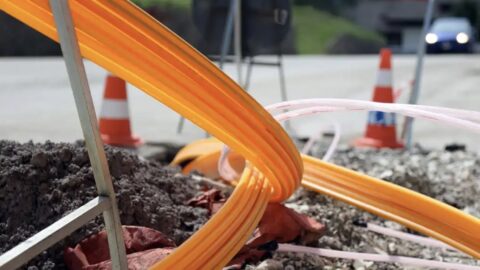
Switching to fiber optics is currently the best possible investment for business IT connections. Are there any particular drawbacks to adopting this connection technology? Or are the costs still high? We answer the main questions about adopting fiber optics in business, and together we'll understand the advantages for your company!
Speed
A recent study by SanDisk found that a weak and slow internet connection can cost up to a week of work per year, even if the time "lost" waiting for downloads or uploads due to a slow network might seem limited. A company's internet connection should never limit its productivity; on the contrary, it should be the tool that adapts to production workflows and accelerates execution. Fiber optics is significantly faster than traditional copper cable, achieving transmission speeds of 100 Gbps, making it by far the highest-performing solution among the various connection types.
Cloud access
As a consequence of the first point, fiber optics enables faster access to the cloud. From customer relationship management (CRM) systems to data storage, the cloud is an important business tool for many functions. The speed and bandwidth of fiber optics translate into faster access to data and applications in the cloud. Salespeople and front-office staff will be able to serve customers without delay and communicate with them in real time without interruption.
Reliability
Unreliable internet connections often translate into real costs for businesses: any unplanned outage can bring communication and production to a complete standstill. Fiber optics is significantly more stable than copper and less susceptible to atmospheric phenomena and electrical and human interference; it is therefore preferable in any situation where a reliable connection is crucial.
Signal strength
In traditional copper or Ethernet internet connections, the signal degrades directly proportionally to the distance from the switch. With a fiber optic connection, the signal degrades much later and over much greater distances: businesses expanding across large areas can easily benefit from a more stable signal at every point thanks to fiber optic installation.
Bandwidth
For businesses that need to transmit large amounts of data, sometimes very large files, it's relatively easy to saturate copper lines. With fiber optics, although internet connections may be limited by the chosen data plan, the available bandwidth is significantly higher. Applications such as web conferencing, streaming, file sharing, and cloud computing tools can greatly benefit from a fiber optic connection.
Symmetrical speed
One of the advantages of fiber optics is the acquisition of equal speeds upstream and downstream, which allows employees to download large videos while downloading other files, make calls or video conferences in the middle of a multi-gigabyte download.
Latency
Latency is the delay with which a data packet is delivered over an internet connection. Thanks to fiber optics, we eliminate a large part of the latency-related problems in uses such as video conferencing, VoIP calls, and generally anywhere there is real-time communication.
Savings
Although it may be costly initially to install or convert your IT ecosystem to fiber optics, the long-term economic benefits are considerable: having a reliable, fast, symmetrical, and durable connection, as we have seen, can help a business avoid drops or interruptions in productivity.
Furthermore, if a company wishes to gradually adopt on-the-cloud solutions, thanks to fiber, it will already be able to use these technologies without slowdowns or costly upgrades.
Security
Hackers and information thieves can physically intercept copper connections with relative ease; with fiber, this is much more difficult, if not impossible, thus limiting the risk of cyberattacks. Furthermore, fiber is almost unaffected by electromagnetic interference from machines within the company.